Tag: AI

  • What is an AI algorithm?

    What is an AI algorithm?

    AI algorithms are constantly advancing, and new papers and services are being published every day.

    On the other hand, some systems that are currently called “AI” actually run on classical algorithms. Many of them are based on old-fashioned statistical methods.

    In this article, I will list representative algorithms of AI and introduce the basic algorithm mechanism.


    What is an AI algorithm?

    The word ” algorithm ” is difficult to describe in one sentence. Above all, there is also no proper translation in Japanese.

    When the word ” algorithm ” is commonly used, it refers to some procedure. Algorithm in AI is also close to its understanding, and in short, it refers to “calculation procedure”.

    Basic structure of the algorithm

    The most common algorithm is “sort”. For example, let’s consider the problem “Sort the horizontally aligned numbers in ascending order”.

    There are various ways to solve the problem and ways of thinking about it, but let’s simply check the magnitude relationship of the numbers from the left.

    If the number on the right is smaller than the number on the left, the left-right relationship is flipped. Repeat this process until the number on the right is greater than the number on the left.
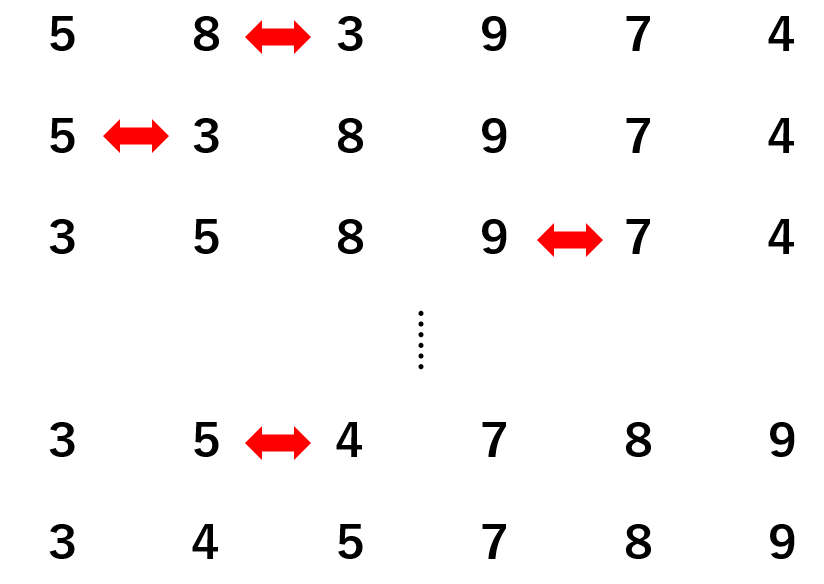
     

    This procedure is the procedure of calculation, that is, the algorithm. Did you get an image of the algorithm?

    Advantages of Algorithms

    By implementing an algorithm programmatically, anyone with that program can use that algorithm.

    Algorithms in AI are similar, and even if we don’t know how the algorithm works or how it is mathematically designed, we can get results just by using that algorithm. .

    This is because algorithms implemented in programming are in the form of “functions”. A programmatic function is something that transforms input into output.

    It’s perfectly fine for us to use the program without knowing how the functions work internally.

    But understanding how algorithms work can give us a better understanding of AI itself. In this article, I will introduce various algorithms, but for the sake of intuitiveness, I will try to avoid mathematical explanations.

    Algorithms for supervised learning

    Regression and classification

    Supervised learning methods can be broadly divided into regression and classification. Regression techniques deal with the problem of “predicting future numbers” for some data, while classification techniques deal with the problem of “predicting which class some data belongs to”.

    In other words, regression techniques deal with ‘continuous values’, whereas classification techniques deal with ‘discrete values’. The figure below shows the difference between regression and classification.

    regression analysis

    Regression analysis predicts the target variable you want to predict based on various other explanatory variables.

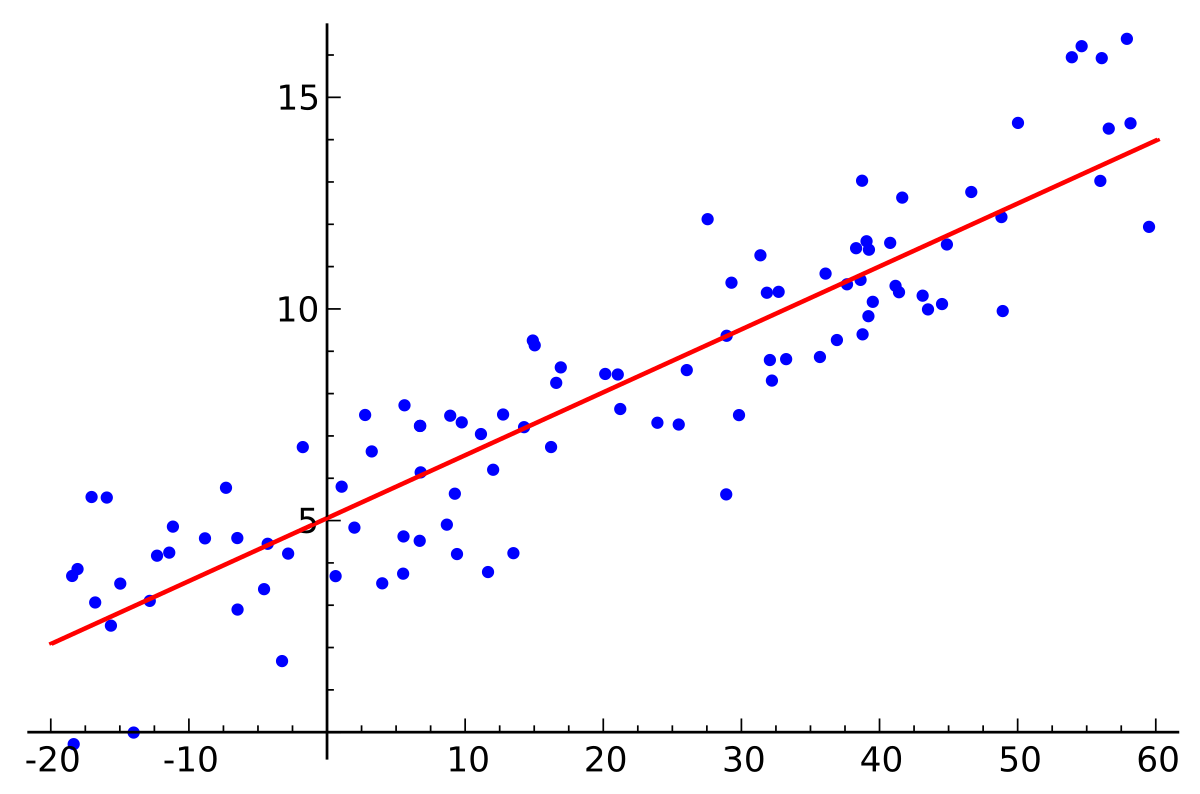
    When there is only one explanatory variable, it is called simple regression analysis. By interpreting the objective variable y as the dependent variable and the explanatory variable x as the independent variable, simple regression analysis can be expressed as a linear function of the form “y=ax+b” with a and b as parameters. When there are multiple explanatory variables, it is called multiple regression analysis.
    What is an AI algorithm?


    There is a distinction between “linear regression” and “nonlinear regression” in regression analysis. This is an intuitive explanation that lacks rigor, but a regression analysis that can linearly express the relationship shown in the figure above, in other words, the relationship between data is called “linear regression.”

    k-nearest neighbor method

    A typical classification problem algorithm is “k-nearest neighbor”. It determines to which class unknown data belongs to class-divided data scattered on coordinates.

    Extract k pieces of data from the unknown data in descending order of distance, and sort the unknown data into the class with the largest number among the k pieces of data. The diagram is as follows.
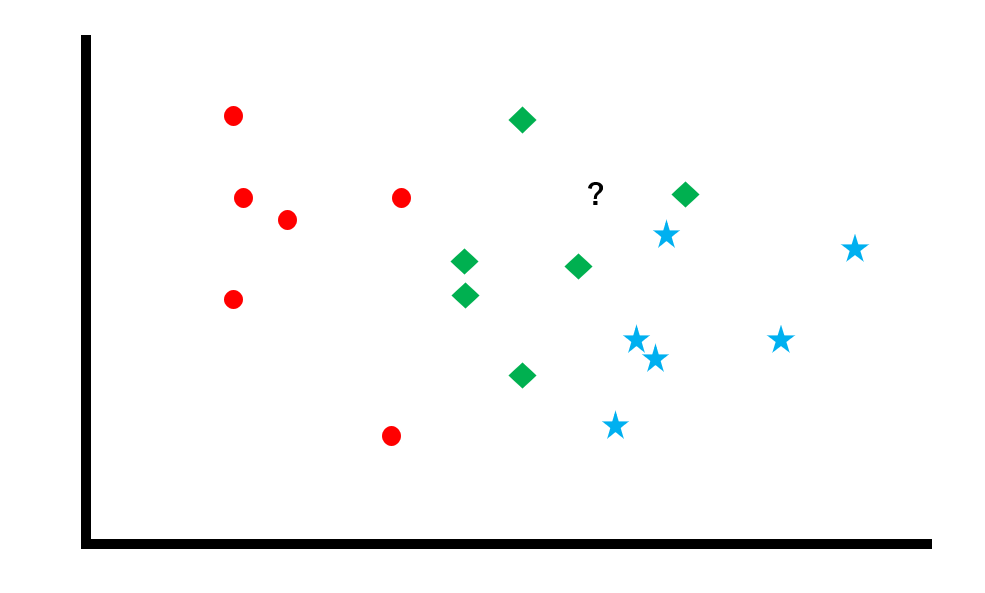
    Determine to which class the unknown data belongs to the already labeled data group. In this example, there are three classes: the red circle class, the blue star class, and the green diamond class.

    Next, with k=3, three data are extracted from the unknown data in descending order of distance. In this example, there are 1 blue star and 2 green diamonds, so a majority vote is taken to determine that this unknown data belongs to the green diamond class.

    Random forest

    A random forest is a combination of several algorithms called “ decision trees ”. It may be easier to understand what a decision tree is by expressing it in a flow chart as shown below.

    The image above shows a decision tree with YES/NO answers to questions.

    Random forest refers to an algorithm that arranges multiple decision trees and decides the result by majority vote.
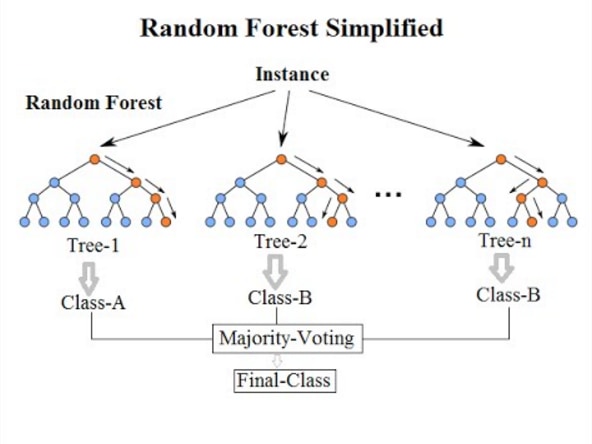
    Also, since there are two types of decision trees: regression decision trees and classification decision trees, random forests can handle both problems.

    Support vector machine

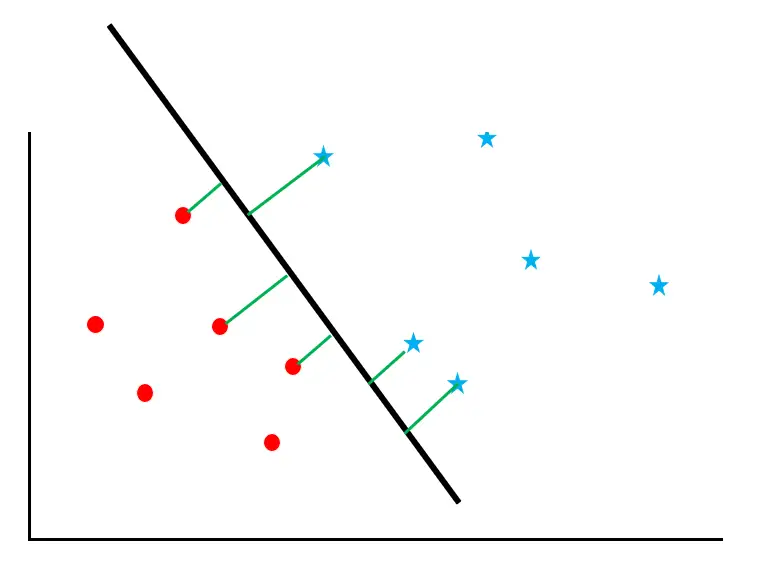
    A support vector machine is an algorithm that calculates “margin maximization” for a data group. Let’s follow the process with reference to the diagram.

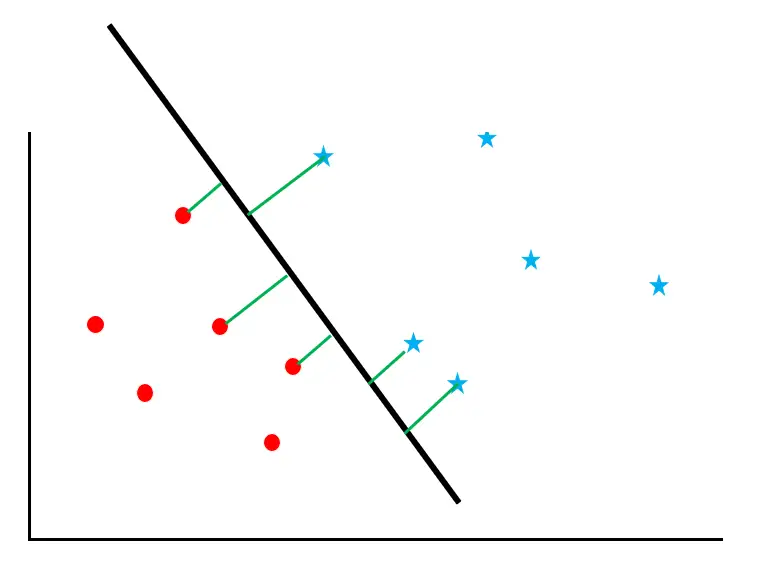
    Let’s consider the problem of separating red circles and blue stars from scattered data with a “boundary line”. However, as you can see in this figure, there are many ways to draw the line.
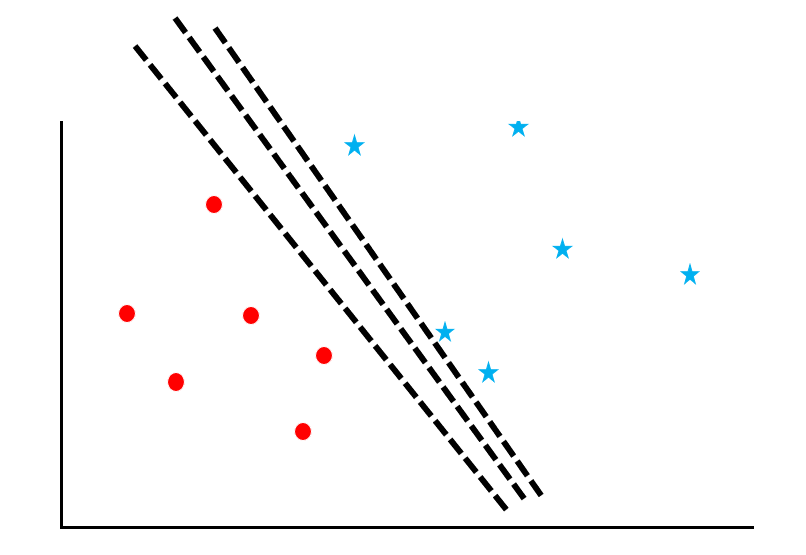
    Now consider “maximizing the support vector margin”. Support vectors refer to the data near the border, and margin refers to the distance between the border and the data. The green line in the figure is the margin.
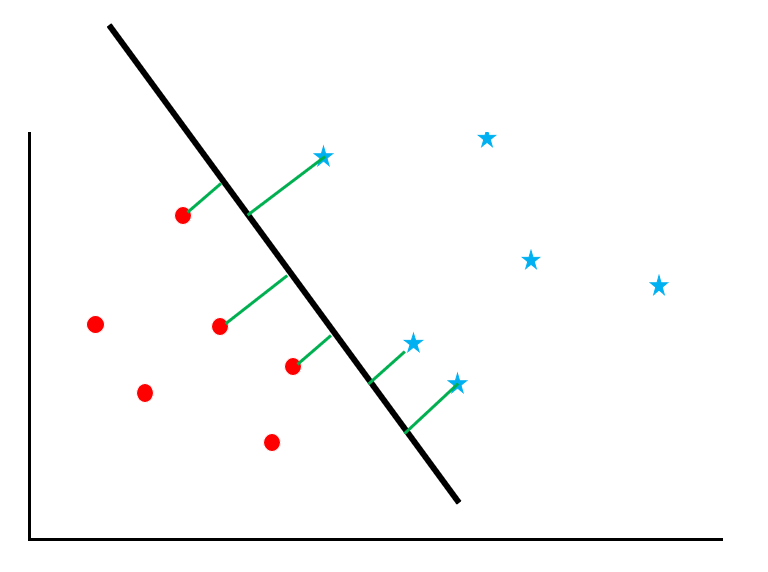
    The line that maximizes this margin is taken as the boundary line. This way you can avoid “false positives”. This is because maximizing the margin reduces the number of data that are ambiguous as to which of the two classes they belong to.

    This support vector machine is an algorithm that can be used for both regression and classification problems.

    Algorithms for unsupervised learning

    clustering

    A typical unsupervised learning algorithm is ” clustering “.

    Clustering is an algorithm for grouping unknown data. The difference from the so-called classification ( supervised learning ) algorithm can be expressed as shown in the figure below.

    k-means method

    The k-means method is the most commonly used clustering algorithm.

    First, randomly determine k centroid points for the scattered data group and use them as the core.
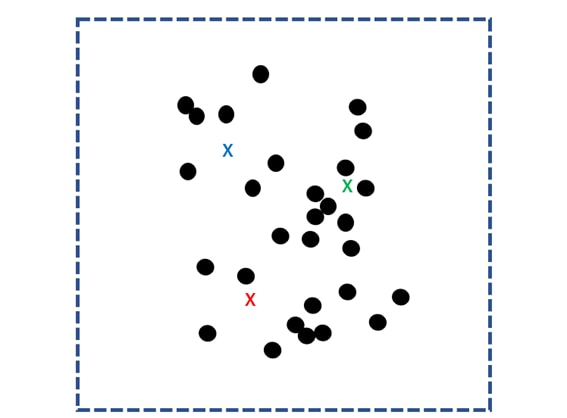
    Then, the distances to the k nuclei are calculated for all data and grouped into the closest nuclei. This group is called a “cluster”.
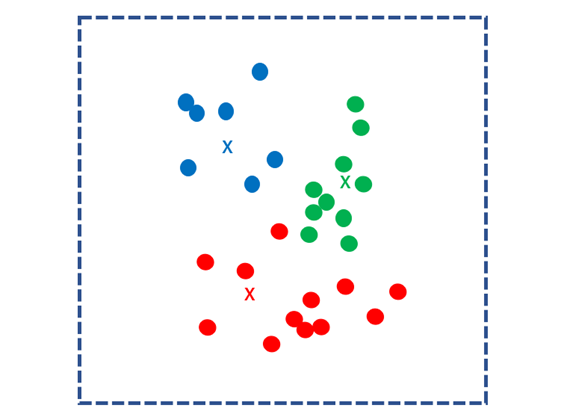
    Next, find the center of gravity for each cluster and use it as the new k kernels. Repeat the same process to separate each data into the nearest centroid clusters.
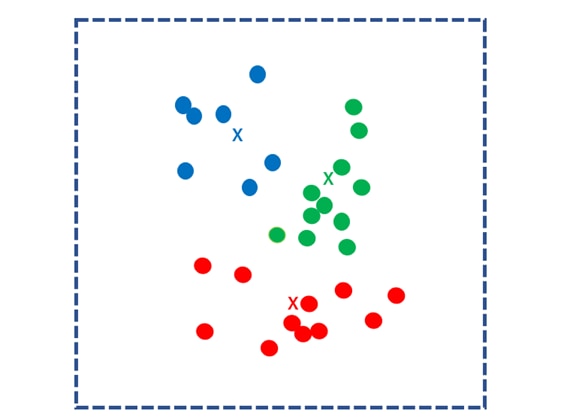
    Repeat this process until the center of mass no longer moves. The calculation ends when the centroid point is no longer updated.

    Reinforcement learning algorithm

    Q-learning

    Q-learning is an “algorithm that learns the Q value”. Understanding mathematical formulas is an unavoidable part of learning Q-learning, but here I will try to simplify it as much as possible.

    Q-learning can be expressed by the following formula.

    This algorithm can be interpreted as “choose the action a that maximizes the reward r in the state s”.

    The expected value of the reward that can be obtained by taking that action is expressed as the Q value. Since the current state s is created as a result of accumulating the value of past actions, the current state s always has a Q value. And you can update the Q value depending on what action you take next. Choosing the action with the highest Q value increases the chances of reaching the reward.

    There are two types of parameters, α and γ. α is the “learning rate”, which determines how quickly the Q value is updated. γ is the “discount rate” and represents how much we can trust the Q-value of the next action to incorporate it into the current Q-value . Optimizing this will result in proper learning.

    Other reinforcement learning algorithms

    Other reinforcement learning algorithms include Monte Carlo and SARSA. The Monte Carlo method is a fairly classical algorithm, but it takes a long time to learn because the reward-seeking process cannot be sequential.

    A reinforcement learning algorithm called TD learning overcomes this drawback, and SARSA belongs to the same TD learning algorithm as Q learning.

    Summary 

    In this article, we introduced a typical AI algorithm. Understanding algorithms leads to understanding how Artificial Intelligence works.

    The algorithms presented here are the most basic and only scratch the surface. It will be more advanced content, but if you are interested in the latest AI, it is a good idea to follow the trend of cutting-edge algorithms.

    Interestingly, some classical AI algorithms have achieved great results by combining them with deep learning techniques. The mechanism of AI is still in the stage of fumbling, and you can see that it is ” not easy “.
     

    Follow us on Facebook for updates and exclusive content! Click here: Each Techy

  • What is an AI algorithm?

    What is an AI algorithm?

    AI algorithms are constantly advancing, and new papers and services are being published every day.

    On the other hand, some systems that are currently called “AI” actually run on classical algorithms. Many of them are based on old-fashioned statistical methods.

    In this article, I will list representative algorithms of AI and introduce the basic algorithm mechanism.


    What is an AI algorithm?

    The word ” algorithm ” is difficult to describe in one sentence. Above all, there is also no proper translation in Japanese.

    When the word ” algorithm ” is commonly used, it refers to some procedure. Algorithm in AI is also close to its understanding, and in short, it refers to “calculation procedure”.

    Basic structure of the algorithm

    The most common algorithm is “sort”. For example, let’s consider the problem “Sort the horizontally aligned numbers in ascending order”.

    There are various ways to solve the problem and ways of thinking about it, but let’s simply check the magnitude relationship of the numbers from the left.

    If the number on the right is smaller than the number on the left, the left-right relationship is flipped. Repeat this process until the number on the right is greater than the number on the left.


    This procedure is the procedure of calculation, that is, the algorithm. Did you get an image of the algorithm?

    Advantages of Algorithms

    By implementing an algorithm programmatically, anyone with that program can use that algorithm.

    Algorithms in AI are similar, and even if we don’t know how the algorithm works or how it is mathematically designed, we can get results just by using that algorithm. .

    This is because algorithms implemented in programming are in the form of “functions”. A programmatic function is something that transforms input into output.

    It’s perfectly fine for us to use the program without knowing how the functions work internally.

    But understanding how algorithms work can give us a better understanding of AI itself. In this article, I will introduce various algorithms, but for the sake of intuitiveness, I will try to avoid mathematical explanations.

    Algorithms for supervised learning

    Regression and classification

    Supervised learning methods can be broadly divided into regression and classification. Regression techniques deal with the problem of “predicting future numbers” for some data, while classification techniques deal with the problem of “predicting which class some data belongs to”.

    In other words, regression techniques deal with ‘continuous values’, whereas classification techniques deal with ‘discrete values’. The figure below shows the difference between regression and classification.

    regression analysis

    Regression analysis predicts the target variable you want to predict based on various other explanatory variables.

    When there is only one explanatory variable, it is called simple regression analysis. By interpreting the objective variable y as the dependent variable and the explanatory variable x as the independent variable, simple regression analysis can be expressed as a linear function of the form “y=ax+b” with a and b as parameters. When there are multiple explanatory variables, it is called multiple regression analysis.

    What is an AI algorithm?


    There is a distinction between “linear regression” and “nonlinear regression” in regression analysis. This is an intuitive explanation that lacks rigor, but a regression analysis that can linearly express the relationship shown in the figure above, in other words, the relationship between data is called “linear regression.”

    k-nearest neighbor method

    A typical classification problem algorithm is “k-nearest neighbor”. It determines to which class unknown data belongs to class-divided data scattered on coordinates.

    Extract k pieces of data from the unknown data in descending order of distance, and sort the unknown data into the class with the largest number among the k pieces of data. The diagram is as follows.

    Determine to which class the unknown data belongs to the already labeled data group. In this example, there are three classes: the red circle class, the blue star class, and the green diamond class.

    Next, with k=3, three data are extracted from the unknown data in descending order of distance. In this example, there are 1 blue star and 2 green diamonds, so a majority vote is taken to determine that this unknown data belongs to the green diamond class.

    Random forest

    A random forest is a combination of several algorithms called “ decision trees ”. It may be easier to understand what a decision tree is by expressing it in a flow chart as shown below.

    The image above shows a decision tree with YES/NO answers to questions.

    Random forest refers to an algorithm that arranges multiple decision trees and decides the result by majority vote.

    Also, since there are two types of decision trees: regression decision trees and classification decision trees, random forests can handle both problems.

    Support vector machine

    A support vector machine is an algorithm that calculates “margin maximization” for a data group. Let’s follow the process with reference to the diagram.

    Let’s consider the problem of separating red circles and blue stars from scattered data with a “boundary line”. However, as you can see in this figure, there are many ways to draw the line.

    Now consider “maximizing the support vector margin”. Support vectors refer to the data near the border, and margin refers to the distance between the border and the data. The green line in the figure is the margin.

    The line that maximizes this margin is taken as the boundary line. This way you can avoid “false positives”. This is because maximizing the margin reduces the number of data that are ambiguous as to which of the two classes they belong to.

    This support vector machine is an algorithm that can be used for both regression and classification problems.

    Algorithms for unsupervised learning

    clustering

    A typical unsupervised learning algorithm is ” clustering “.

    Clustering is an algorithm for grouping unknown data. The difference from the so-called classification ( supervised learning ) algorithm can be expressed as shown in the figure below.

    k-means method

    The k-means method is the most commonly used clustering algorithm.

    First, randomly determine k centroid points for the scattered data group and use them as the core.

    Then, the distances to the k nuclei are calculated for all data and grouped into the closest nuclei. This group is called a “cluster”.

    Next, find the center of gravity for each cluster and use it as the new k kernels. Repeat the same process to separate each data into the nearest centroid clusters.

    Repeat this process until the center of mass no longer moves. The calculation ends when the centroid point is no longer updated.

    Reinforcement learning algorithm

    Q-learning

    Q-learning is an “algorithm that learns the Q value”. Understanding mathematical formulas is an unavoidable part of learning Q-learning, but here I will try to simplify it as much as possible.

    Q-learning can be expressed by the following formula.

    This algorithm can be interpreted as “choose the action a that maximizes the reward r in the state s”.

    The expected value of the reward that can be obtained by taking that action is expressed as the Q value. Since the current state s is created as a result of accumulating the value of past actions, the current state s always has a Q value. And you can update the Q value depending on what action you take next. Choosing the action with the highest Q value increases the chances of reaching the reward.

    There are two types of parameters, α and γ. α is the “learning rate”, which determines how quickly the Q value is updated. γ is the “discount rate” and represents how much we can trust the Q-value of the next action to incorporate it into the current Q-value . Optimizing this will result in proper learning.

    Other reinforcement learning algorithms

    Other reinforcement learning algorithms include Monte Carlo and SARSA. The Monte Carlo method is a fairly classical algorithm, but it takes a long time to learn because the reward-seeking process cannot be sequential.

    A reinforcement learning algorithm called TD learning overcomes this drawback, and SARSA belongs to the same TD learning algorithm as Q learning.

    Summary 

    In this article, we introduced a typical AI algorithm. Understanding algorithms leads to understanding how Artificial Intelligence works.

    The algorithms presented here are the most basic and only scratch the surface. It will be more advanced content, but if you are interested in the latest AI, it is a good idea to follow the trend of cutting-edge algorithms.

    Interestingly, some classical AI algorithms have achieved great results by combining them with deep learning techniques. The mechanism of AI is still in the stage of fumbling, and you can see that it is ” not easy “.

     

    Follow us on Facebook for updates and exclusive content! Click here: Each Techy

  • What is an AI algorithm?

    What is an AI algorithm?

    AI algorithms are constantly advancing, and new papers and services are being published every day.

    On the other hand, some systems that are currently called “AI” actually run on classical algorithms. Many of them are based on old-fashioned statistical methods.

    In this article, I will list representative algorithms of AI and introduce the basic algorithm mechanism.


    What is an AI algorithm?

    The word ” algorithm ” is difficult to describe in one sentence. Above all, there is also no proper translation in Japanese.

    When the word ” algorithm ” is commonly used, it refers to some procedure. Algorithm in AI is also close to its understanding, and in short, it refers to “calculation procedure”.

    Basic structure of the algorithm

    The most common algorithm is “sort”. For example, let’s consider the problem “Sort the horizontally aligned numbers in ascending order”.

    There are various ways to solve the problem and ways of thinking about it, but let’s simply check the magnitude relationship of the numbers from the left.

    If the number on the right is smaller than the number on the left, the left-right relationship is flipped. Repeat this process until the number on the right is greater than the number on the left.


    This procedure is the procedure of calculation, that is, the algorithm. Did you get an image of the algorithm?

    Advantages of Algorithms

    By implementing an algorithm programmatically, anyone with that program can use that algorithm.

    Algorithms in AI are similar, and even if we don’t know how the algorithm works or how it is mathematically designed, we can get results just by using that algorithm. .

    This is because algorithms implemented in programming are in the form of “functions”. A programmatic function is something that transforms input into output.

    It’s perfectly fine for us to use the program without knowing how the functions work internally.

    But understanding how algorithms work can give us a better understanding of AI itself. In this article, I will introduce various algorithms, but for the sake of intuitiveness, I will try to avoid mathematical explanations.

    Algorithms for supervised learning

    Regression and classification

    Supervised learning methods can be broadly divided into regression and classification. Regression techniques deal with the problem of “predicting future numbers” for some data, while classification techniques deal with the problem of “predicting which class some data belongs to”.

    In other words, regression techniques deal with ‘continuous values’, whereas classification techniques deal with ‘discrete values’. The figure below shows the difference between regression and classification.

    regression analysis

    Regression analysis predicts the target variable you want to predict based on various other explanatory variables.

    When there is only one explanatory variable, it is called simple regression analysis. By interpreting the objective variable y as the dependent variable and the explanatory variable x as the independent variable, simple regression analysis can be expressed as a linear function of the form “y=ax+b” with a and b as parameters. When there are multiple explanatory variables, it is called multiple regression analysis.

    What is an AI algorithm?


    There is a distinction between “linear regression” and “nonlinear regression” in regression analysis. This is an intuitive explanation that lacks rigor, but a regression analysis that can linearly express the relationship shown in the figure above, in other words, the relationship between data is called “linear regression.”

    k-nearest neighbor method

    A typical classification problem algorithm is “k-nearest neighbor”. It determines to which class unknown data belongs to class-divided data scattered on coordinates.

    Extract k pieces of data from the unknown data in descending order of distance, and sort the unknown data into the class with the largest number among the k pieces of data. The diagram is as follows.

    Determine to which class the unknown data belongs to the already labeled data group. In this example, there are three classes: the red circle class, the blue star class, and the green diamond class.

    Next, with k=3, three data are extracted from the unknown data in descending order of distance. In this example, there are 1 blue star and 2 green diamonds, so a majority vote is taken to determine that this unknown data belongs to the green diamond class.

    Random forest

    A random forest is a combination of several algorithms called “ decision trees ”. It may be easier to understand what a decision tree is by expressing it in a flow chart as shown below.

    The image above shows a decision tree with YES/NO answers to questions.

    Random forest refers to an algorithm that arranges multiple decision trees and decides the result by majority vote.

    Also, since there are two types of decision trees: regression decision trees and classification decision trees, random forests can handle both problems.

    Support vector machine

    A support vector machine is an algorithm that calculates “margin maximization” for a data group. Let’s follow the process with reference to the diagram.

    Let’s consider the problem of separating red circles and blue stars from scattered data with a “boundary line”. However, as you can see in this figure, there are many ways to draw the line.

    Now consider “maximizing the support vector margin”. Support vectors refer to the data near the border, and margin refers to the distance between the border and the data. The green line in the figure is the margin.

    The line that maximizes this margin is taken as the boundary line. This way you can avoid “false positives”. This is because maximizing the margin reduces the number of data that are ambiguous as to which of the two classes they belong to.

    This support vector machine is an algorithm that can be used for both regression and classification problems.

    Algorithms for unsupervised learning

    clustering

    A typical unsupervised learning algorithm is ” clustering “.

    Clustering is an algorithm for grouping unknown data. The difference from the so-called classification ( supervised learning ) algorithm can be expressed as shown in the figure below.

    k-means method

    The k-means method is the most commonly used clustering algorithm.

    First, randomly determine k centroid points for the scattered data group and use them as the core.

    Then, the distances to the k nuclei are calculated for all data and grouped into the closest nuclei. This group is called a “cluster”.

    Next, find the center of gravity for each cluster and use it as the new k kernels. Repeat the same process to separate each data into the nearest centroid clusters.

    Repeat this process until the center of mass no longer moves. The calculation ends when the centroid point is no longer updated.

    Reinforcement learning algorithm

    Q-learning

    Q-learning is an “algorithm that learns the Q value”. Understanding mathematical formulas is an unavoidable part of learning Q-learning, but here I will try to simplify it as much as possible.

    Q-learning can be expressed by the following formula.

    This algorithm can be interpreted as “choose the action a that maximizes the reward r in the state s”.

    The expected value of the reward that can be obtained by taking that action is expressed as the Q value. Since the current state s is created as a result of accumulating the value of past actions, the current state s always has a Q value. And you can update the Q value depending on what action you take next. Choosing the action with the highest Q value increases the chances of reaching the reward.

    There are two types of parameters, α and γ. α is the “learning rate”, which determines how quickly the Q value is updated. γ is the “discount rate” and represents how much we can trust the Q-value of the next action to incorporate it into the current Q-value . Optimizing this will result in proper learning.

    Other reinforcement learning algorithms

    Other reinforcement learning algorithms include Monte Carlo and SARSA. The Monte Carlo method is a fairly classical algorithm, but it takes a long time to learn because the reward-seeking process cannot be sequential.

    A reinforcement learning algorithm called TD learning overcomes this drawback, and SARSA belongs to the same TD learning algorithm as Q learning.

    Summary 

    In this article, we introduced a typical AI algorithm. Understanding algorithms leads to understanding how Artificial Intelligence works.

    The algorithms presented here are the most basic and only scratch the surface. It will be more advanced content, but if you are interested in the latest AI, it is a good idea to follow the trend of cutting-edge algorithms.

    Interestingly, some classical AI algorithms have achieved great results by combining them with deep learning techniques. The mechanism of AI is still in the stage of fumbling, and you can see that it is ” not easy “.


    Follow us on Facebook for updates and exclusive content! Click here: Each Techy

  • What is Cloud AI?

    What is Cloud AI?

    Due to improvements in database technology and network technology, the use of cloud AI, which processes AI in the cloud, is progressing.

    With further technological innovations such as the development of 5G, the role played by cloud AI will become even greater.

    Recently, an increasing number of companies are recognising the importance of data and promoting data utilisation, and the cloud plays a major role in the processing of such data and its processing speed.

    This time, we will explain the advantages and disadvantages of cloud AI and the situations where it can be actually introduced and utilised with examples. And I will also explain the difference from edge AI, which has been a hot topic recently.


    What is cloud AI?

    Starting with Gmail, the cloud is something that many people are familiar with. The name cloud originated in 2006 when then-Google CEO Eric Schmidt called the service “cloud computing.”

    In the latter half of the 1990, Internet use spread rapidly as computer prices began to fall in the Internet age. At that time, many companies were overwhelmed with internet speeds, applications and data, and server sprawl. In addition, it was difficult to handle such a server because it was necessary to rent or prepare it yourself, and it was necessary to design the capacity in advance.

    In the 2000, the cloud was the solution to this problem. This technology has made it possible to easily use necessary services with software and data via the Internet.

    Furthermore, the cloud is indispensable for IoT technology, which is a hot topic these days. For example, services are being developed that allow users to operate and manage home appliances from their smartphones while away from home. The amount of data sent by these services is extremely large ( big data ), and cannot be covered by the servers owned by one company. Cloud services are used for this purpose. In addition to being able to expand freely, the cloud eliminates the need for server management and keeps costs low, so it can greatly reduce the burden on companies.

    Looking at the background to the birth of the cloud and its current use, I think you can understand why AI is being used in the cloud.

    Three benefits of cloud AI

    The benefits of using cloud AI are:

    • No load on your server
    • Complex and advanced processing possible
    • Easy management such as application of learned data

    I will explain in detail from now on.

    No load on your server

    Cloud AI is a mechanism that performs AI learning and data processing on the cloud, so there is no need to perform complex information processing on your own server or terminal, which can reduce the load.

    The computer that processes information on the cloud is also provided by the data server, so it can be said that there is no need to prepare a high-performance computer in-house.

    Complex and advanced processing possible

    Cloud AI accumulates data on a large-scale server and processes and analyzes the data, making it possible to perform complex and advanced processing.

    The great strength of cloud AI is that it can process a huge amount of information that cannot be processed by AI installed in small terminals such as personal computers.

    Easy management such as application of learned data

    One of the challenges in introducing AI is the preparation of data for learning.

    When using cloud AI, learning data is prepared in advance on the cloud, and highly accurate AI that has learned from that data can be used.

    Since there is no need to prepare highly reliable data or perform installation work such as building a learning model, AI can be used without advanced knowledge of AI.

    3 Disadvantages of Cloud AI

    Disadvantages of using cloud AI are as follows.

      • When sending and receiving a large amount of data, processing via the Internet lacks real-time performance.
    • Risk of information leakage
    • As the amount of data increases, the amount of communication increases

    I will explain in detail from now on.

    Sending and receiving huge amounts of data lacks real-time performance

    Cloud AI sends and receives information from the terminal at hand to the cloud and processes information on the cloud.

    If you need to send or receive a large amount of data, you may exceed your data bandwidth and experience delays.

    However, in recent years, the use of 5G lines, which are capable of transmitting and receiving more data, is increasing, so it is expected that cloud AI will be able to be used in real time in the future.

    Risk of information leakage

    When using cloud AI, all information must be sent to the cloud via the Internet, increasing the risk of information leakage.

    There is also a risk of information leakage while information is stored on the cloud.

    It can be said that confidential information such as internal secrets is not suitable for processing with cloud AI.

    As the amount of data increases, the amount of communication increases

    Internet connection is used to send data from the terminal to the cloud.

    As the amount of data increases, the amount of communication increases, which not only increases the risk of delays but also increases communication costs.

    There are costs that can be cut by using cloud AI, such as not having to manage AI in-house, so it is necessary to consider what kind of service to use in consideration of other costs.

    Differences between cloud AI and edge AI

    In recent years, there is a technology called “edge AI”.

    As the use of IoT is promoted and AI technology advances, the lack of real-time performance and privacy issues, which I mentioned earlier as the disadvantages of cloud AI, have come to the fore.

    That’s where edge AI comes in. In cloud AI, data accumulation, learning, and inference were all performed on the cloud, but in edge AI, inference can be performed without using the cloud by incorporating a learning model into a terminal (edge ​​device).

    Edge AI has the following features.

    • Real-time performance can be secured because the prediction is performed on the end device (edge ​​device)
    • Security is strong because prediction is performed without going through the Internet
    •  Communication cost savings

    Edge AI is attracting a great deal of attention, especially in research on industrial machinery and self-driving cars, as a technology that can successfully compensate for the disadvantages of cloud AI.

    Disadvantages of edge AI and recent technological developments

    However, Edge AI also has its disadvantages.

      • Incompetence of edge devices (compactness, power consumption in inference, etc.)
      • Advanced prediction is not possible because the environment for learning (cloud side) and the environment for inference (edge ​​device side) are (sometimes) different.
      • Security is not perfect as data is (may be) sent to the cloud to generate learning models

    Due to the above problems, edge AI alone has been considered insufficient.

    Therefore, in recent years, edge AI that combines high efficiency, high-speed processing, and small size has been developed, and there are great expectations for it as the IoT society advances.

    Led by the New Energy and Industrial Technology Development Organization (NEDO), private companies and universities are developing computer technology and AI chips that can achieve both high speed and ultra-low power consumption.

    Furthermore, edge AI startup AISing Inc. announced last December that it had developed an ultra-compact edge AI algorithm called “Memory Saving Tree (MST)” that can be placed on your fingertips.


    This memory-saving “MST” is expected to be introduced in a wide variety of fields such as home appliances, smartwatches, and automobiles.

    In this way, the development of edge AI is currently being actively carried out, and it is attracting attention as an important technology that supports the Quaternary industry.

    3 AI cloud services

    Here are three AI cloud services.

      1. Google Cloud Platform
    1. Amazon Web Services
    2. Microsoft Azure

    ①Google Cloud Platform

    Google Cloud Platform is an AI cloud service provided by Google, and it is a cloud service that implements various functions such as more than 20 free functions, paid functions, and business functions.

    It is an easy-to-use service for those who are thinking of using the AI ​​cloud service for the first time, such as new users can receive usage rights for $ 300.

    It provides a function to manage large amounts of data and a function to cluster images.

    (2) Amazon Web Services

    Amazon Web Services is an AI cloud service provided by Amazon, and is attractive for its diverse functions and rich free experience.

    There are three types of free functions: free for a short period of time, free for one year, and unlimited, and there are over 100 services that you can try for free.

    It is attractive that various services such as machine learning, log analysis, and relational database services can be used free of charge.

    We also have extensive support for start-up companies.

    ③Microsoft Azure

    Microsoft Azure is an AI cloud service provided by Microsoft, and you can experience popular services for free for 12 months.

    After the free trial period ends, we will move to a pay-as-you-go system, but you can continue to use more than 40 services for free.

    AI analyzes customer trends to build mobile experiences, supports the development of new apps, and efficiently manages websites.

    3 Case Studies of Cloud AI Introduction

    (1) Utilization of “XaaS (X as a service)”

    Businesses using cloud AI are currently seen in various places, and among them, the need for cloud computing services such as ” SaaS “, “MaaS”, and ” PaaS ” has been increasing in recent years.

    These various services are collectively called “XaaS”, and services are developed and operated by a wide range of companies, from large companies such as Google and Microsoft to venture companies.

    This time, we will introduce the latest examples of SaaS (Software as a Service), which is attracting particular attention among XaaS.

    ②Material informatics “TABRASA”

    The platform “TABRASA” is a materials informatics (MI) service ( SaaS ) jointly developed by NAGASE and IBM .

    *MI (Materials Informatics): A technology that uses AI to improve the efficiency of research and development by chemists. A search algorithm that uses past material experiments and simulation data makes it possible to develop and commercialize new materials more quickly.

    The feature of this service is that you can search for materials with two engines, “cognitive” and “analytics”.

    “Analytics” is an approach to learn the chemical structural formula and physical property values ​​and derive the chemical structural formula of the substance desired by the user. On the other hand, “cognitive” is an approach that reads papers, patents, encyclopedias, experimental data, etc. related to materials into AI, systematizes them, and makes new guesses and proposals.

    “Cognitive” is a highly customizable and unprecedented approach. The easy-to-understand and easy-to-operate UI makes it possible to use the service even if you are not a research specialist, so it can be applied to a wide range of fields.

    ③ Transcription service “Mojiko”

    “Mojiko” is a “transcription editor” service that uses AI speech recognition technology developed by TBS TV.

    In the TV and radio industry, a lot of “transcription” is done every day, but because it is a very laborious task, it is a heavy burden on the site of program production. In order to reduce the burden of such work as much as possible, TBS TV started developing “Mojiko”.

    As a result, after materials such as audio and video files collected are automatically converted into text by the latest AI speech recognition engines of IT companies, human beings can immediately “correct and edit” sentences that are not correctly recognized. became.

    Currently, TBS licenses “Mojiko” to Yoshizumi Information Co., Ltd. and sells it to general companies. Mojiko is expected to play a role in reforming the way people work in the media industry, where working hours are said to be long.

    Even in industries such as the media industry, where IT and DX are slow to progress, starting with services that are easy to implement will make it easier for XaaS to take root, and it may gradually bring about positive changes in the way work is done.

    In conclusion

    In this article, we have explained a wide range of things, from the background of the creation of the cloud to the technological development and introduction of cloud AI. Did you understand that the existence of this cloud is indispensable for the utilization and development of AI?

    If you follow popular XaaS services, you can see the current movement of the IT society. With the advent of the AI ​​era and the progress of the IoT society, there is a great possibility that cloud and cloud services will further advance in technological development and diversification of services. We will continue to pay attention to cloud technology, which will be the “unsung hero” that will create a new society.

    Follow us on Facebook for updates and exclusive content! Click here: Each Techy
  • What is Cloud AI?

    What is Cloud AI?

    Due to improvements in database technology and network technology, the use of cloud AI, which processes AI in the cloud, is progressing.

    With further technological innovations such as the development of 5G, the role played by cloud AI will become even greater.

    Recently, an increasing number of companies are recognising the importance of data and promoting data utilisation, and the cloud plays a major role in the processing of such data and its processing speed.

    This time, we will explain the advantages and disadvantages of cloud AI and the situations where it can be actually introduced and utilised with examples. And I will also explain the difference from edge AI, which has been a hot topic recently.


    What is cloud AI?

    Starting with Gmail, the cloud is something that many people are familiar with. The name cloud originated in 2006 when then-Google CEO Eric Schmidt called the service “cloud computing.”

    In the latter half of the 1990, Internet use spread rapidly as computer prices began to fall in the Internet age. At that time, many companies were overwhelmed with internet speeds, applications and data, and server sprawl. In addition, it was difficult to handle such a server because it was necessary to rent or prepare it yourself, and it was necessary to design the capacity in advance.

    In the 2000, the cloud was the solution to this problem. This technology has made it possible to easily use necessary services with software and data via the Internet.

    Furthermore, the cloud is indispensable for IoT technology, which is a hot topic these days. For example, services are being developed that allow users to operate and manage home appliances from their smartphones while away from home. The amount of data sent by these services is extremely large ( big data ), and cannot be covered by the servers owned by one company. Cloud services are used for this purpose. In addition to being able to expand freely, the cloud eliminates the need for server management and keeps costs low, so it can greatly reduce the burden on companies.

    Looking at the background to the birth of the cloud and its current use, I think you can understand why AI is being used in the cloud.

    Three benefits of cloud AI

    The benefits of using cloud AI are:

    • No load on your server
    • Complex and advanced processing possible
    • Easy management such as application of learned data

    I will explain in detail from now on.

    No load on your server

    Cloud AI is a mechanism that performs AI learning and data processing on the cloud, so there is no need to perform complex information processing on your own server or terminal, which can reduce the load.

    The computer that processes information on the cloud is also provided by the data server, so it can be said that there is no need to prepare a high-performance computer in-house.

    Complex and advanced processing possible

    Cloud AI accumulates data on a large-scale server and processes and analyzes the data, making it possible to perform complex and advanced processing.

    The great strength of cloud AI is that it can process a huge amount of information that cannot be processed by AI installed in small terminals such as personal computers.

    Easy management such as application of learned data

    One of the challenges in introducing AI is the preparation of data for learning.

    When using cloud AI, learning data is prepared in advance on the cloud, and highly accurate AI that has learned from that data can be used.

    Since there is no need to prepare highly reliable data or perform installation work such as building a learning model, AI can be used without advanced knowledge of AI.

    3 Disadvantages of Cloud AI

    Disadvantages of using cloud AI are as follows.

      • When sending and receiving a large amount of data, processing via the Internet lacks real-time performance.
    • Risk of information leakage
    • As the amount of data increases, the amount of communication increases

    I will explain in detail from now on.

    Sending and receiving huge amounts of data lacks real-time performance

    Cloud AI sends and receives information from the terminal at hand to the cloud and processes information on the cloud.

    If you need to send or receive a large amount of data, you may exceed your data bandwidth and experience delays.

    However, in recent years, the use of 5G lines, which are capable of transmitting and receiving more data, is increasing, so it is expected that cloud AI will be able to be used in real time in the future.

    Risk of information leakage

    When using cloud AI, all information must be sent to the cloud via the Internet, increasing the risk of information leakage.

    There is also a risk of information leakage while information is stored on the cloud.

    It can be said that confidential information such as internal secrets is not suitable for processing with cloud AI.

    As the amount of data increases, the amount of communication increases

    Internet connection is used to send data from the terminal to the cloud.

    As the amount of data increases, the amount of communication increases, which not only increases the risk of delays but also increases communication costs.

    There are costs that can be cut by using cloud AI, such as not having to manage AI in-house, so it is necessary to consider what kind of service to use in consideration of other costs.

    Differences between cloud AI and edge AI

    In recent years, there is a technology called “edge AI”.

    As the use of IoT is promoted and AI technology advances, the lack of real-time performance and privacy issues, which I mentioned earlier as the disadvantages of cloud AI, have come to the fore.

    That’s where edge AI comes in. In cloud AI, data accumulation, learning, and inference were all performed on the cloud, but in edge AI, inference can be performed without using the cloud by incorporating a learning model into a terminal (edge ​​device).

    Edge AI has the following features.

    • Real-time performance can be secured because the prediction is performed on the end device (edge ​​device)
    • Security is strong because prediction is performed without going through the Internet
    •  Communication cost savings

    Edge AI is attracting a great deal of attention, especially in research on industrial machinery and self-driving cars, as a technology that can successfully compensate for the disadvantages of cloud AI.

    Disadvantages of edge AI and recent technological developments

    However, Edge AI also has its disadvantages.

      • Incompetence of edge devices (compactness, power consumption in inference, etc.)
      • Advanced prediction is not possible because the environment for learning (cloud side) and the environment for inference (edge ​​device side) are (sometimes) different.
      • Security is not perfect as data is (may be) sent to the cloud to generate learning models

    Due to the above problems, edge AI alone has been considered insufficient.

    Therefore, in recent years, edge AI that combines high efficiency, high-speed processing, and small size has been developed, and there are great expectations for it as the IoT society advances.

    Led by the New Energy and Industrial Technology Development Organization (NEDO), private companies and universities are developing computer technology and AI chips that can achieve both high speed and ultra-low power consumption.

    Furthermore, edge AI startup AISing Inc. announced last December that it had developed an ultra-compact edge AI algorithm called “Memory Saving Tree (MST)” that can be placed on your fingertips.


    This memory-saving “MST” is expected to be introduced in a wide variety of fields such as home appliances, smartwatches, and automobiles.

    In this way, the development of edge AI is currently being actively carried out, and it is attracting attention as an important technology that supports the Quaternary industry.

    3 AI cloud services

    Here are three AI cloud services.

      1. Google Cloud Platform
    1. Amazon Web Services
    2. Microsoft Azure

    ①Google Cloud Platform

    Google Cloud Platform is an AI cloud service provided by Google, and it is a cloud service that implements various functions such as more than 20 free functions, paid functions, and business functions.

    It is an easy-to-use service for those who are thinking of using the AI ​​cloud service for the first time, such as new users can receive usage rights for $ 300.

    It provides a function to manage large amounts of data and a function to cluster images.

    (2) Amazon Web Services

    Amazon Web Services is an AI cloud service provided by Amazon, and is attractive for its diverse functions and rich free experience.

    There are three types of free functions: free for a short period of time, free for one year, and unlimited, and there are over 100 services that you can try for free.

    It is attractive that various services such as machine learning, log analysis, and relational database services can be used free of charge.

    We also have extensive support for start-up companies.

    ③Microsoft Azure

    Microsoft Azure is an AI cloud service provided by Microsoft, and you can experience popular services for free for 12 months.

    After the free trial period ends, we will move to a pay-as-you-go system, but you can continue to use more than 40 services for free.

    AI analyzes customer trends to build mobile experiences, supports the development of new apps, and efficiently manages websites.

    3 Case Studies of Cloud AI Introduction

    (1) Utilization of “XaaS (X as a service)”

    Businesses using cloud AI are currently seen in various places, and among them, the need for cloud computing services such as ” SaaS “, “MaaS”, and ” PaaS ” has been increasing in recent years.

    These various services are collectively called “XaaS”, and services are developed and operated by a wide range of companies, from large companies such as Google and Microsoft to venture companies.

    This time, we will introduce the latest examples of SaaS (Software as a Service), which is attracting particular attention among XaaS.

    ②Material informatics “TABRASA”

    The platform “TABRASA” is a materials informatics (MI) service ( SaaS ) jointly developed by NAGASE and IBM .

    *MI (Materials Informatics): A technology that uses AI to improve the efficiency of research and development by chemists. A search algorithm that uses past material experiments and simulation data makes it possible to develop and commercialize new materials more quickly.

    The feature of this service is that you can search for materials with two engines, “cognitive” and “analytics”.

    “Analytics” is an approach to learn the chemical structural formula and physical property values ​​and derive the chemical structural formula of the substance desired by the user. On the other hand, “cognitive” is an approach that reads papers, patents, encyclopedias, experimental data, etc. related to materials into AI, systematizes them, and makes new guesses and proposals.

    “Cognitive” is a highly customizable and unprecedented approach. The easy-to-understand and easy-to-operate UI makes it possible to use the service even if you are not a research specialist, so it can be applied to a wide range of fields.

    ③ Transcription service “Mojiko”

    “Mojiko” is a “transcription editor” service that uses AI speech recognition technology developed by TBS TV.

    In the TV and radio industry, a lot of “transcription” is done every day, but because it is a very laborious task, it is a heavy burden on the site of program production. In order to reduce the burden of such work as much as possible, TBS TV started developing “Mojiko”.

    As a result, after materials such as audio and video files collected are automatically converted into text by the latest AI speech recognition engines of IT companies, human beings can immediately “correct and edit” sentences that are not correctly recognized. became.

    Currently, TBS licenses “Mojiko” to Yoshizumi Information Co., Ltd. and sells it to general companies. Mojiko is expected to play a role in reforming the way people work in the media industry, where working hours are said to be long.

    Even in industries such as the media industry, where IT and DX are slow to progress, starting with services that are easy to implement will make it easier for XaaS to take root, and it may gradually bring about positive changes in the way work is done.

    In conclusion

    In this article, we have explained a wide range of things, from the background of the creation of the cloud to the technological development and introduction of cloud AI. Did you understand that the existence of this cloud is indispensable for the utilization and development of AI?

    If you follow popular XaaS services, you can see the current movement of the IT society. With the advent of the AI ​​era and the progress of the IoT society, there is a great possibility that cloud and cloud services will further advance in technological development and diversification of services. We will continue to pay attention to cloud technology, which will be the “unsung hero” that will create a new society.

    Follow us on Facebook for updates and exclusive content! Click here: Each Techy
  • 4 Ways your startup can take advantage of AI today !

    4 Ways your startup can take advantage of AI today !

    To find out if your startup needs AI today, start by prioritizing your business problem. Let’s frame the best approach to solving these challenges and evaluate how technology can help. In most cases, you will be able to work effectively with basic analytics, statistics, or simple machine learning.

    In some situations AI horsepower is needed. In such scenarios, additional intelligence and automation will transform your startup. This article is for such cases.\

    When people feel the need for AI, the next question they often ask is, “Do we really need a big budget to use AI?” The answer to this question is no. It doesn’t take months of hard work, elite data scientists, or a big budget to make your business AI-driven.

    Here are four ways your startup or small business can start using AI today. These suggestions are laid out in order from easiest to hardest, so start at the top and see which option best fits your needs.

    (*Translation Note 1) Mr. Kesari, the author of this article , published an article titled ” When should we not invest in AI? ” on January 9, 2021 in the business media “Entrepreneur” Asia Pacific Edition .
    Here are the five situations in which AI should not be invested, according to Mr.5 Situations Where You Shouldn’t Invest in AI

    1. When a problem can be solved in a simpler way: If a problem can be solved without AI, then the cheaper and simpler solution should be implemented.
    2. When you don’t have enough training data: Introducing AI is useless if you don’t have enough data to train it.
    3. When the effect of introducing AI has not been proven: It is dangerous to introduce AI to problems in domains where the effect of introducing AI has not been sufficiently proven.
    4. When the cost outweighs the benefits: Even if AI is introduced, maintenance costs are required. If this cost outweighs the benefits, AI should not be introduced.
    5. When Humans Should Get Involved: Even if AI’s ability to solve problems surpasses humans’, there are situations where humans should get involved. For example, even if AI outperforms human doctors in diagnosing cancer, it should be a human being who announces cancer.

    1. Enabling AI features for tools you already use

    AI is all around us. Your smartphone probably has at least a dozen AI-powered apps. This technology is empowering us to take better photos with our cameras, organize our photos, and curate our social feeds.

    Most enterprise tools are adding AI-powered features to their products. Microsoft has built some AI features into Excel. If you insert data from screenshots or take advantage of the insights suggested by Excel’s Ideas panel, you’re using AI. 

    Salesforce has integrated Einstein , the company’s AI engine, as an intelligent assistant across its popular CRM (customer relationship management) platforms. Some companies will bundle AI capabilities into their core products, while others will need to upgrade.

    Ask your vendor if the software you buy has AI capabilities. Existing toolsets may already be AI-driven, or could be adapted with a simple upgrade.

    Five popular tools in this option: MS Office , Google for Business , Dropbox , Github , Mixmax

    How to insert data in Excel is explained in this help page.

    2. Buy off-the-shelf AI-powered SaaS tools

    Today, SaaS (Software as a Service) tools are plentiful and available for a reasonable monthly fee. Want to polish your marketing copy? Grammarly ‘s handy copy-editing feature covers the good stuff. Want to transcribe testimonial videos or do professional-grade media editing? Descript ‘s AI features make it easy.

    If you have an unmet business need, look for functional SaaS tools with intelligent features. Most SaaS tools come with built-in integrations that make it easy to integrate into your existing IT ecosystem. Even if it doesn’t fit perfectly, what matters is whether it solves most of the problems. If so, you can avoid investing in expensive enterprise licenses for similar AI capabilities.

    Evaluate the available tools against your key requirements. Check for matching coverage and ease of integration. If the results of your investigation exceed the acceptable range, let’s hurry to postpone the hiring.

    Five popular tools in this option: Zoho Zia , Trello , Grammarly , Descript , WaveApps

    3. Incorporation of ready-made AI models into tools

    If you can’t find a tool with built-in intelligence, the next best thing is to search the cloud for AI models that you can connect to the tool. For example, if you’re trying to find manufacturing defects in a product, AI can be used to automate visual inspection. Amazon Lookout for Vision is a cloud-based machine learning (ML) service that plugs directly into your workflow.

    Unlike the previous step, this step requires DevOps capabilities (including software development and IT operations). It also doesn’t require data scientists, but the team will need programming expertise to link software applications to online AI models. Also pay attention to the subscription cost, which is determined by usage.

    To consider this option, identify an online ML platform that has pre-built AI models to solve your domain problem. The space has seen promising startups such as Clarifai, Dialogflow, and SightHound, as well as big players such as Microsoft, Google, and Amazon.

    Five popular tools in this option: ML on AWS , Azure ML , Google Cloud ML , Clarifai , Sighthound

    4. Retraining publicly available AI models

    Once you’ve exhausted the options above, hire a data scientist to train an AI model in-house. Save effort by reusing publicly available AI algorithms and easily curated datasets instead of starting from scratch. These resources can be applied to solve your problem.

    For example, let’s say your startup needs to understand customer satisfaction by analyzing text feedback from customer surveys. For that, we need algorithms with natural language processing (NLP) capabilities. Instead of painstakingly training new AI models , teams can build AI models based on models that have won public competitions such as Kaggle , DrivenData and AICrowd .

    The best things on the Internet are often free, but it takes time to find them. Look for open repositories like HuggingFace that publish models with pre-trained weights, or communities that publish ML models like PapersWithCode . Many of these sites share rich and curated data that can accelerate the process of model building. As a team, evaluate the effort required to adapt the published models (to the problem you want to solve) and determine the cost of maintaining them as a product.


    Being AI-driven is a journey, not a destination

    In this article, we’ve seen four ways to get started with AI and get the most out of your resources. While starting an AI journey is often straightforward, it requires ongoing attention and investment to deliver consistent business value.

    Enterprises will need to train users, restructure organizational workflows, and manage the cultural shifts associated with AI adoption. It’s also important to regularly review the total cost of ownership (TCO) of your AI investment. A valid option today may be expensive a year from now.

    For example, a subscription to an AI-powered SaaS tool (shown as the second option) might be a good fit for a small team serving an early customer base. As teams grow and usage increases, subscription costs can become prohibitive. At such a stage, you may find it more economical to hire a small team of data scientists and retrain publicly available AI models (option 4).

    We have summarized what options are available to streamline decision-making regarding AI introduction.


    Follow us on Facebook for updates and exclusive content! Click here: Each Techy

  • 4 Ways your startup can take advantage of AI today !

    4 Ways your startup can take advantage of AI today !

    To find out if your startup needs AI today, start by prioritizing your business problem. Let’s frame the best approach to solving these challenges and evaluate how technology can help. In most cases, you will be able to work effectively with basic analytics, statistics, or simple machine learning.

    In some situations AI horsepower is needed. In such scenarios, additional intelligence and automation will transform your startup. This article is for such cases.\

    When people feel the need for AI, the next question they often ask is, “Do we really need a big budget to use AI?” The answer to this question is no. It doesn’t take months of hard work, elite data scientists, or a big budget to make your business AI-driven.

    Here are four ways your startup or small business can start using AI today. These suggestions are laid out in order from easiest to hardest, so start at the top and see which option best fits your needs.

    (*Translation Note 1) Mr. Kesari, the author of this article , published an article titled ” When should we not invest in AI? ” on January 9, 2021 in the business media “Entrepreneur” Asia Pacific Edition .
    Here are the five situations in which AI should not be invested, according to Mr.5 Situations Where You Shouldn’t Invest in AI

    1. When a problem can be solved in a simpler way: If a problem can be solved without AI, then the cheaper and simpler solution should be implemented.
    2. When you don’t have enough training data: Introducing AI is useless if you don’t have enough data to train it.
    3. When the effect of introducing AI has not been proven: It is dangerous to introduce AI to problems in domains where the effect of introducing AI has not been sufficiently proven.
    4. When the cost outweighs the benefits: Even if AI is introduced, maintenance costs are required. If this cost outweighs the benefits, AI should not be introduced.
    5. When Humans Should Get Involved: Even if AI’s ability to solve problems surpasses humans’, there are situations where humans should get involved. For example, even if AI outperforms human doctors in diagnosing cancer, it should be a human being who announces cancer.

    1. Enabling AI features for tools you already use

    AI is all around us. Your smartphone probably has at least a dozen AI-powered apps. This technology is empowering us to take better photos with our cameras, organize our photos, and curate our social feeds.

    Most enterprise tools are adding AI-powered features to their products. Microsoft has built some AI features into Excel. If you insert data from screenshots or take advantage of the insights suggested by Excel’s Ideas panel, you’re using AI. 

    Salesforce has integrated Einstein , the company’s AI engine, as an intelligent assistant across its popular CRM (customer relationship management) platforms. Some companies will bundle AI capabilities into their core products, while others will need to upgrade.

    Ask your vendor if the software you buy has AI capabilities. Existing toolsets may already be AI-driven, or could be adapted with a simple upgrade.

    Five popular tools in this option: MS Office , Google for Business , Dropbox , Github , Mixmax

    How to insert data in Excel is explained in this help page.

    2. Buy off-the-shelf AI-powered SaaS tools

    Today, SaaS (Software as a Service) tools are plentiful and available for a reasonable monthly fee. Want to polish your marketing copy? Grammarly ‘s handy copy-editing feature covers the good stuff. Want to transcribe testimonial videos or do professional-grade media editing? Descript ‘s AI features make it easy.

    If you have an unmet business need, look for functional SaaS tools with intelligent features. Most SaaS tools come with built-in integrations that make it easy to integrate into your existing IT ecosystem. Even if it doesn’t fit perfectly, what matters is whether it solves most of the problems. If so, you can avoid investing in expensive enterprise licenses for similar AI capabilities.

    Evaluate the available tools against your key requirements. Check for matching coverage and ease of integration. If the results of your investigation exceed the acceptable range, let’s hurry to postpone the hiring.

    Five popular tools in this option: Zoho Zia , Trello , Grammarly , Descript , WaveApps

    3. Incorporation of ready-made AI models into tools

    If you can’t find a tool with built-in intelligence, the next best thing is to search the cloud for AI models that you can connect to the tool. For example, if you’re trying to find manufacturing defects in a product, AI can be used to automate visual inspection. Amazon Lookout for Vision is a cloud-based machine learning (ML) service that plugs directly into your workflow.

    Unlike the previous step, this step requires DevOps capabilities (including software development and IT operations). It also doesn’t require data scientists, but the team will need programming expertise to link software applications to online AI models. Also pay attention to the subscription cost, which is determined by usage.

    To consider this option, identify an online ML platform that has pre-built AI models to solve your domain problem. The space has seen promising startups such as Clarifai, Dialogflow, and SightHound, as well as big players such as Microsoft, Google, and Amazon.

    Five popular tools in this option: ML on AWS , Azure ML , Google Cloud ML , Clarifai , Sighthound

    4. Retraining publicly available AI models

    Once you’ve exhausted the options above, hire a data scientist to train an AI model in-house. Save effort by reusing publicly available AI algorithms and easily curated datasets instead of starting from scratch. These resources can be applied to solve your problem.

    For example, let’s say your startup needs to understand customer satisfaction by analyzing text feedback from customer surveys. For that, we need algorithms with natural language processing (NLP) capabilities. Instead of painstakingly training new AI models , teams can build AI models based on models that have won public competitions such as Kaggle , DrivenData and AICrowd .

    The best things on the Internet are often free, but it takes time to find them. Look for open repositories like HuggingFace that publish models with pre-trained weights, or communities that publish ML models like PapersWithCode . Many of these sites share rich and curated data that can accelerate the process of model building. As a team, evaluate the effort required to adapt the published models (to the problem you want to solve) and determine the cost of maintaining them as a product.


    Being AI-driven is a journey, not a destination

    In this article, we’ve seen four ways to get started with AI and get the most out of your resources. While starting an AI journey is often straightforward, it requires ongoing attention and investment to deliver consistent business value.

    Enterprises will need to train users, restructure organizational workflows, and manage the cultural shifts associated with AI adoption. It’s also important to regularly review the total cost of ownership (TCO) of your AI investment. A valid option today may be expensive a year from now.

    For example, a subscription to an AI-powered SaaS tool (shown as the second option) might be a good fit for a small team serving an early customer base. As teams grow and usage increases, subscription costs can become prohibitive. At such a stage, you may find it more economical to hire a small team of data scientists and retrain publicly available AI models (option 4).

    We have summarized what options are available to streamline decision-making regarding AI introduction.


    Follow us on Facebook for updates and exclusive content! Click here: Each Techy